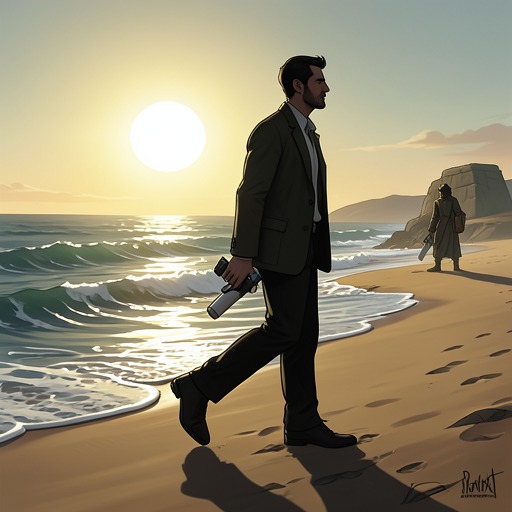
The beach outside Algiers
The Stranger (Albert Camus Edition)The beach outside Algiers is the central physical setting of the novel's decisive turning point. Reached by bus from the city, it initially offers Meursault and Marie Cardona swimming, erotic intimacy, and the possibility of marriage; by the end of the day, however, it has become the scene of an armed confrontation, a killing, and the irreversible movement toward Meursault's arrest and trial. The beach's overwhelming sun and heat do not merely decorate the action: they shape Meursault's bodily perception until the landscape seems to press him toward a fatal act.
Setting and Arrival
The beach lies some miles outside Algiers, a strip of sand between two rocky spurs, with rushes along the tide line. Meursault and Marie arrive on a Saturday after taking a bus from the city. The route from the stop crosses a high plateau overlooking the sea and then descends steeply toward the sands. Yellowish pebbles, wild lilies, small houses with wooden balconies, tamarisks, and green or white palings compose the approach, while the sea appears smooth and reflective beneath a hard, metallic sky. A distant fishing boat moves almost imperceptibly across the dazzling water, giving the setting an expansive stillness before the plot turns violent.
Raymond Sintès brings them to a small wooden bungalow owned by his friend Masson. The structure rests against the cliff at its rear and stands on piles at the front, where the water already laps beneath it. Masson and his wife welcome the visitors, promise fried fish for lunch, and treat the bungalow as a place for weekends and holidays. The domestic hospitality of the bungalow establishes the beach as an informal social space, contrasting with the police station and the legal institutions that later interpret what happens there.
Pleasure, Intimacy, and Social Possibility
Before the conflict becomes visible, the beach is associated with bodily ease and shared pleasure. The water is pleasantly tepid, and Marie teaches Meursault a game involving waves, foam, and spray. She then embraces him in the water and kisses him. After they dress, they remain silent, kiss again, and hurry back toward the bus and Meursault's apartment. The beach therefore extends their attraction into a physical world of swimming, sunlight, and salt water, while the return journey leads directly to sexual intimacy.
The visit also briefly alters Meursault's relation to marriage. At Masson's bungalow, Marie and Masson's wife get along, laughing and chatting together, and Meursault seriously considers the possibility of marrying Marie. This thought arises not through a declaration or a formal decision, but from the ordinary arrangement of the day: a welcoming household, a cheerful companion, food, bathing, and the prospect of returning home together. The beach thus holds out a temporary image of social belonging before the violence destroys its calm.
The Feud and the Escalation of Violence
The threat already accompanies the party when they leave for the beach. On the street before taking the bus, Raymond points out several Arabs watching them near a tobacconist's window and identifies the second man from the left as the person involved in his feud. The previous evening, Meursault had given evidence for Raymond at the police station concerning Raymond's claim that a girl had been unfaithful to him; Raymond had been released with a warning, and the authorities had not checked Meursault's statement. The beach excursion is therefore connected to Raymond's earlier violence and to the institutional validation, however limited, of his account.
At the beach, two Arabs in blue dungarees approach Raymond, Masson, and Meursault. Raymond assumes that they followed the group after seeing them take the bus and noticing Marie's oilcloth bathing bag. He assigns each man a role in a possible fight, telling Masson to take the second Arab, asking Meursault to assist if another attacker appears, and preparing to confront the man who bears him a grudge. When the groups meet, Raymond strikes his opponent, while Masson hits the other man twice and knocks him into the water. Raymond continues beating his own opponent and declares that he has not finished, but Meursault warns him that the man has a knife. The knife slashes Raymond, transforming the beach from a site of recreation into the immediate setting of bloodshed.
After lunch, Raymond decides to walk alone and becomes angry when Masson and Meursault offer to accompany him. Meursault nevertheless follows. At the far end of the beach, beside a small stream that has cut a channel through the sand from behind a rock, they find the two Arabs again. The scene has temporarily lost the appearance of active combat: the men lie on the sand, one staring silently, the other playing three notes repeatedly on a reed. Yet Raymond places his hand near his revolver and asks Meursault whether he should shoot the man. The apparent quiet is therefore not reconciliation but suspended danger, with the weapon making the possibility of renewed violence explicit.
Heat, Perception, and the Killing
The beach's physical conditions intensify the scene. At midday, the light is nearly vertical, the glare from the water sears the eyes, heat rises from the rocks, and breathing becomes difficult. Later, as Meursault walks toward the boulders, the sun appears to splinter across the sand in flakes of fire. He wants to recover the cool shadow near the rock and hear the stream again, imagining relief from glare, tears, strain, and effort. The movement toward shade is at once a physical aim and a movement back toward the unresolved encounter.
The Arab has returned alone and lies partly shaded by the rock while the sun beats on the rest of his body. On seeing Meursault, he raises himself and reaches toward his pocket. Meursault grips Raymond's revolver, though he remains far away and intermittently sees the man only as a blurred form in the heat haze. He recognizes that he could turn away, walk back, and end the encounter, but the pressure of the heated beach seems to bear down on him. The memory of the heat at Madame Meursault's funeral returns through the same sensations in his forehead, linking the beach to an earlier experience of bodily oppression and emotional disconnection.
When Meursault advances one more step, the Arab draws his knife and holds it across the sunlight. The reflected blade becomes, in Meursault's perception, a piercing shaft of light; sweat and salt blind him, while the sun's assault overwhelms ordinary judgment. He fires the revolver once, then four additional shots into the inert body. The first shot breaks what he calls the balance of the day and the calm of the beach; each later shot deepens the act's finality and seals his undoing. The beach consequently functions not as a neutral backdrop but as the sensory field through which a contingent confrontation becomes an irreversible killing.
From Physical Place to Legal Evidence
After Meursault's arrest, the beach is no longer encountered as a lived landscape of water, shade, and heat. At the first formal examinations, officials ask about his identity and other basic details, while the examining magistrate begins to scrutinize the case. The location's complex sequence—Raymond's feud, the earlier assault, the knife, the heat, the pause by the stream, and the five shots—is progressively translated into legal procedure.
Raymond's courtroom testimony further narrows the beach's meaning. He explains that the dead man, rather than Meursault, had a personal grudge against him because Raymond had beaten up the man's sister; he presents Meursault's presence on the beach as a pure coincidence. When the prosecutor asks how the letter that led to the tragedy could have been Meursault's work, Raymond again calls it chance. The court thus treats the beach as a site where personal relations, colonial racial categories, and legal responsibility must be assigned, but the testimony gives the dead man little individual voice. The two Arabs are repeatedly identified by collective designation, while Raymond, Meursault, the police, and the court occupy the visible positions of speaking and being believed.
Narrative Significance
The beach concentrates the novel's major oppositions: pleasure and violence, freedom and consequence, bodily sensation and legal abstraction, coincidence and apparent design. Its route begins with flowers, sea air, swimming, and Marie's companionship, then passes through Raymond's unresolved feud, a knife fight, a stream-side standoff, and the blinding glare that precedes the shots. The same setting can therefore seem idyllic, threatening, and judicially incriminating without changing its physical identity.
Its recurring heat also joins the beach to the novel's wider pattern of sun and bodily pressure. Meursault does not describe the killing primarily as a moral deliberation; he registers glare, sweat, burning sand, the knife's reflected light, and the constriction of his own body. That sensory emphasis neither removes responsibility nor supplies a stable motive. Instead, it preserves the event's disturbing mixture of external pressure, personal involvement, and contingency. The beach is the place where an apparently ordinary excursion becomes the hinge of the entire narrative: intimacy gives way to conflict, conflict to killing, and killing to the institutions that will reconstruct the day in their own language.